How Our Glossary Management System Supercharges Multilingual Teams to Localize 40 Percent Faster
 There are a lot of teams that still rely on simple translators for converting their content, but classic tools very often translate every single word in a literal manner even the terms that should remain unchanged. This results in huge issues in localization of content, web page localization and even localized video, where accuracy matters the most. To illustrate this, let’s suppose a product by the name of “FreshWave.” A simple translator could give an output of “New Wave” which is not only losing the brand identity but also making it sound generic and confusing in another language. It is at this point that a modern TMS with an inbuilt GMS becomes a necessity. Our GMS comes with a feature where the teams can set the protected terms beforehand like brand names, product names, UI components, technical terms and HTML elements to never get changed. It also establishes strict translation rules for terms that are to be translated in a particular way, thus ensuring total consistency across the different markets. By having controlled terminology along with intelligent workflow support, the multilingual teams at last become able to get translations that are accurate, stable and aligned with the brand using already existing professional localization tools, software localization tools and advanced localization software.
The Challenges of Localization Without a Glossary Management System
Maria is a localization editor who is in charge of three markets, several languages and a very tight schedule. She starts her day in the same way she has been for years. She first checks her email and sees a huge pile of messages, that is, from translators, project managers and reviewers, all asking for her help. One person is looking for the approved term for a new feature while another one is inquiring if a tagline should be localized for the French market. The marketing department is asking for clarification on the word choice that was used in last week's campaign. The list of her tasks is growing up before she has even taken a first drink of coffee. In order to solve those questions, Maria takes out a spreadsheet called Glossary_Final_v13. It has been so much updated that no one is sure whether it is the real "final" version or not anymore. She sifts through messy columns, color-coded cells, half-filled tabs and duplicated entries. Different linguists have interpreted the file in different ways. Some are using newly updated terms. Others are sticking with the old terms. A few have even created private versions that have never been returned to the central file. What was supposed to be a reference point has now become a point of confusion. Throughout the day, new issues arise. A translator sends a file for review but Maria notices that the terms are not consistent with the earlier version. She looks into her folder and discovers three different copies of the same document, each with slightly different wording because everyone has been working from different reference points. Now she has to determine which version is the right one and spread the updates throughout the team. On top of all that, the marketing department is asking for information regarding the status of this week’s video and website localization tasks in specific languages. Maria is unsure because she does not know what changes have been sanctioned and what version is under consideration at present. The absence of a common translation management system is a major hindrance in the whole process. Notes disappear in long email conversations. Approvals take an hour instead of a few minutes. And since nobody has an agreed-upon source of truth, discrepancies across languages multiply. Such is the situation in which the majority of teams find themselves when they do not have modern localization software. The tools are disjointed. The terminology is fluctuating. No one is sure of anything. The output gets lower and the anger gets bigger. Moreover, the whole process is affected negatively because the very system brings in barriers.
How a Glossary Management System Transforms Localization Workflows
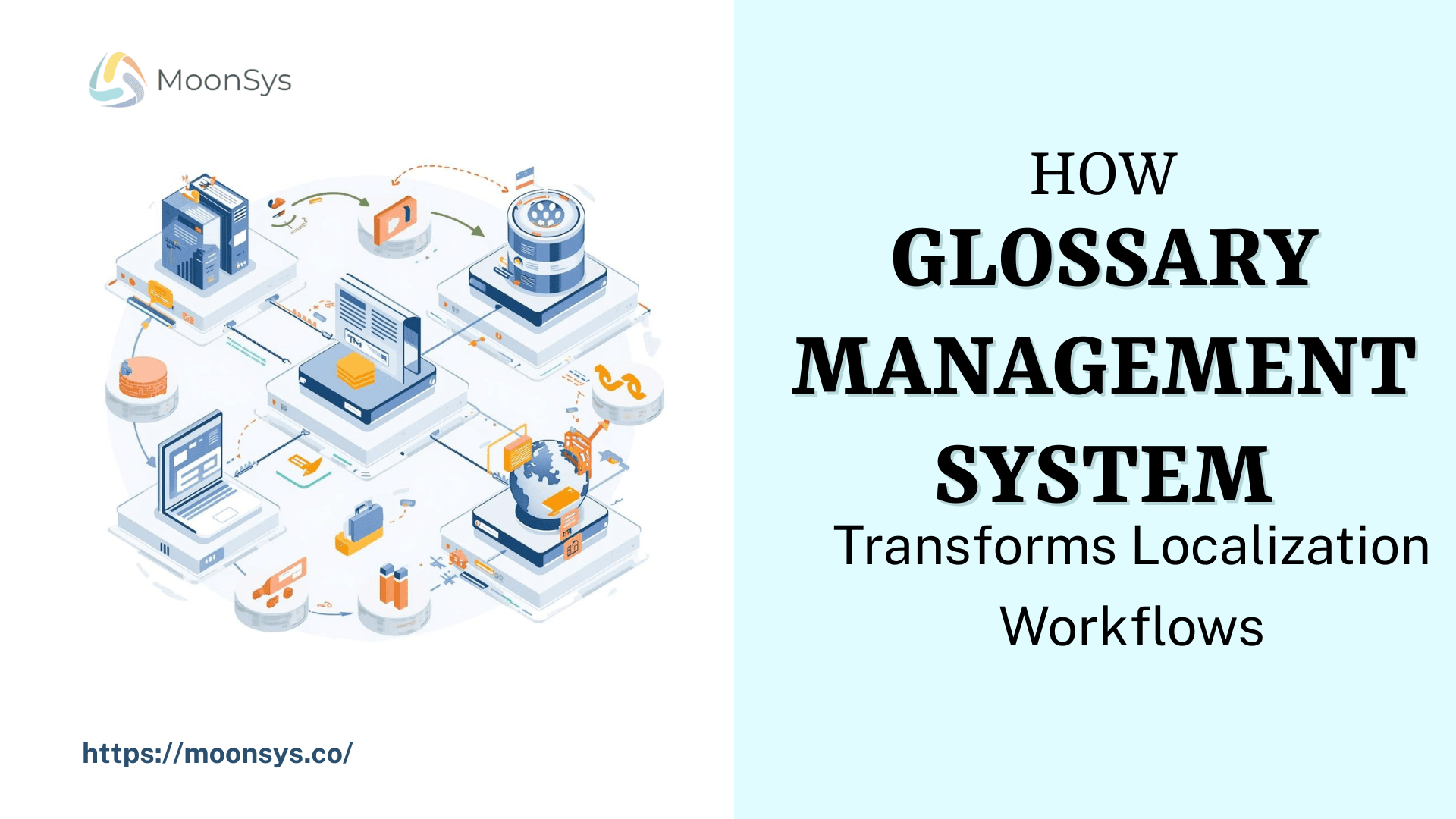 Now picture Maria's day with our glossary-enhanced translation management system. The moment she logs in the distinction is obvious. Instead of chaotic spreadsheets, she has a beautifully structured glossary with all the approved terms clearly shown. If she seeks a word such as “login,” the database will instantly give the results for all language pairs.
Searching Terms Within Seconds
Instead of wading through jumbled files, Maria simply types a word and gets complete context right away. She can resolve translator queries in seconds rather than in hours. What is more, the team does not rely on her for every little clarification anymore since the glossary is self-sufficient containing all they need. Her work process has become lighter, quicker and less taxing.
Entry History and Versioning
The full history of each glossary entry is available. If anyone alters a term, the system will keep a record of the change via the editor, date of change, and the reason for it. Maria can easily see previous versions, make the old ones available again and even sanction changes with just one click. This greatly reduces the usual misunderstanding that comes from the presence of outdated or duplicated files. The whole team now has a constantly updated and correct reference point to rely on.
Container-Based Organization
The glossary is put together in a container-like fashion. The marketing terms have an area of their own. The terms of product UI have another area. Legal terms are under a restricted area for the approved users only. This division makes it easier for the different teams to avoid confusion over the usage of sensitive and market-specific terms. Furthermore, it provides the management with a greater say and control over the manner and place of language product usage.
Multi-Language Pair Support
No matter the case of Maria’s team working with English to German, Japanese to French and Spanish to Arabic, every pair of languages is stored and managed with the same clarity. The translators are no longer dependent on clarifications since everything is already placed in its proper pair.
Notes and Context Usage
A glossary item provides its usage notes, alternative forms, do-not-translate tags, screenshots and project connections from the past. If a term has been associated with a UI element and localized video title, the context is already there during the translation. This helps to avoid misunderstandings and cuts down the time usually taken in revisions by hours.
User-Role Permissions
The permissions of the different team members vary. Translators can view and suggest changes. Editors are able to modify the entries. Managers are the ones who have the final decision on approval. This set-up keeps everything in order and prevents unauthorized modifications.
Import and Export Flexibility
The system accepts the legacy glossaries importation without any troublesome reformatting. It is also quite easy to export the glossary whenever the external vendors want to have reference materials. No more scenarios involving broken spreadsheets, missing columns and inconsistent terminology across the tools.
The Measurable Impact on Workflow and Cost
Her team using the glossary within the translation management system makes the results to be felt instantly. The team is able to complete the tasks in much less time. The review cycles get shorter since the translators do cleaner work from the very beginning. The number of errors due to inconsistently used terminology falls drastically. Moreover, with the glossary being integrated into the translation workflow, every project gets benefited automatically across the tools of software localization, workflows of localization software and even complicated web page localization.
Teams are saying that there is an increase of forty percent in delivery speed. The cost of revision is reduced. Communication is easier since the glossary clears up most doubts even before they arise. Project managers eventually get reliable insight on who is doing what and what version is the correct one. The whole team feels more assured, more unified and thus, more able to produce high-quality multilingual content without unnecessary delays. Your Teams Can Work Like This Too If you're looking for a way to speed up the workflow, eliminate mistakes, and enhance the communication of your translators, editors and project managers, you can consider implementing a glossary-powered translation management system which is the simplest yet most influential upgrade. Your glossary is the truth provider which keeps every step synchronized whether you are dealing with localized video, software localization tools, content localization and multilingual marketing assets.
Clear and unambiguous terminology. Smooth and uncomplicated workflow. Faster and more consistent localization process for your whole team.
If you want your team to go through this change feel free to send me a DM and I will guide you.