Many businesses today face operational challenges because they use outdated software systems which restrict their ability to expand.
Organizations across various sectors depend on systems which have existed for multiple decades. The platforms which were originally designed to support operational processes now function as system bottlenecks. Companies face obstacles in their development because of three main factors which include slow processing speeds and restricted system integration and increasing system maintenance expenses. The real issue is not a lack of technology. The organization needs modern technology yet it relies on outdated systems which lack the capacity to meet current requirements.
Organizations need their legacy systems modernization because it has become necessary. The organization needs to modernize its legacy systems because this process will help the organization achieve sustainable growth and better performance and maintain its competitive edge over time.
The Hidden Cost of Outdated Systems
Research demonstrates that 55 percent of information technology budgets are dedicated to maintaining existing legacy systems. The research indicates that more than half of technology budgets are allocated to maintaining outdated systems instead of developing new systems. The system experiences operational interruptions because of its frequent downtime. Employees and customers experience frustration because of the system's slow performance. Security weaknesses allow unauthorized parties to access confidential information. The organization faces its most significant obstacle through integration. Organizations face difficulties when contemporary analytics and automation tools need to work with existing systems. The current situation prevents organizations from implementing business process automation together with advanced digital systems. The organizations maintain a state of reactivity which prevents them from developing agile capabilities. Organizations need IT modernization to achieve sustainable growth and organizational adaptability while maintaining operational effectiveness in digital transformation.
Rethinking Modernization as Digital Transformation
Organizations should modernize their systems according to their strategic needs instead of replacing all existing components at once. The process requires organizations to carry out application modernization efforts which will boost their performance while their business activities remain unaffected.Organizations can achieve their operational objectives when they implement digital transformation through a carefully designed process which enables them to upgrade their systems. The transformation process includes implementing cloud migration, enabling application program interfaces, refactoring existing code, and integrating different systems. The organization aims to establish an environment which provides both security and flexibility while enabling controlled expansion of resources. Organizations need to adopt future-ready platforms which allow them to operate their business activities without being restricted by outdated system technologies. The updated systems provide organizations with improved capabilities to share data between different functional units. The decision-making process becomes more efficient because system operators can understand information through direct system interactions which enable real-time data access.
The Modernization Journey
Successful modernization begins with a detailed system audit. The process of identifying inefficiencies and outdated components together with performance gaps delivers a straightforward path for system improvement. The process of system implementation allows for partial system upgrades instead of needing to replace entire systems. The process of selecting specific upgrades between current systems results in significant system advancements. A modernization plan requires development as the next step. The project will implement cloud migration services through phased deployment together with API integration which will enhance system connectivity and code optimization efforts to improve system performance and reliability. Phased implementation helps businesses because it minimizes operational dangers while maintaining business operations. The complete system needs both testing and monitoring throughout all stages of its development. The process of continuous optimization enables the upgraded system to show measurable enhancements in performance security and scalability.
The Moonsys Modernization Advantage
 The Moonsys Modernization services enable organizations to update their outdated systems into advanced operational systems which maintain business activities throughout the upgrade process. The team designs a specific modernization plan by assessing existing systems and operational processes and organizational goals.
We maintain essential business operations by updating legacy software to current industry standards. Our system integration process enables us to link existing systems with contemporary platforms which allows for efficient data transfer between the two systems. The organization uses a staged implementation method which reduces system outages while maintaining ongoing business operations.
Our company delivers permanent advantages to clients through enterprise software modernization projects and cloud migration services and performance improvement solutions.
The Moonsys Modernization services enable organizations to update their outdated systems into advanced operational systems which maintain business activities throughout the upgrade process. The team designs a specific modernization plan by assessing existing systems and operational processes and organizational goals.
We maintain essential business operations by updating legacy software to current industry standards. Our system integration process enables us to link existing systems with contemporary platforms which allows for efficient data transfer between the two systems. The organization uses a staged implementation method which reduces system outages while maintaining ongoing business operations.
Our company delivers permanent advantages to clients through enterprise software modernization projects and cloud migration services and performance improvement solutions.
Key Features That Drive Efficiency
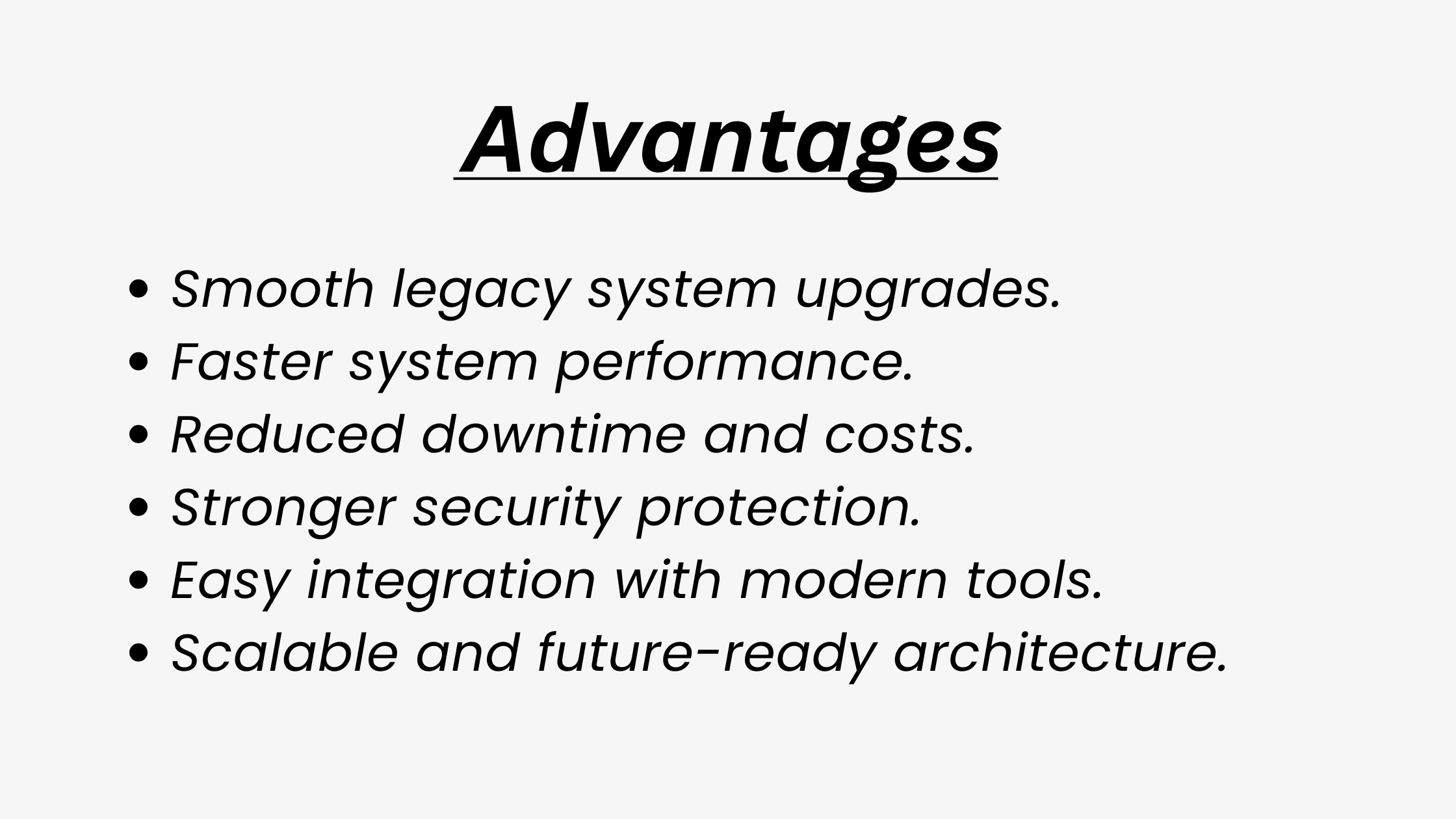
The process of moving systems to cloud environments together with their subsequent integration represents the main approach for achieving modernization goals. The practice of transferring business operations to cloud platforms results in improved operational flexibility and system scalability while reducing expenses. The process of building secure systems protects all confidential information which needs to be safeguarded during system development. The process of code refactoring enables systems to achieve better performance results and control their technical debt. The process of optimizing outdated business systems helps companies achieve more efficient operations and faster business response times. New security systems protect against security threats which previous systems failed to identify. Future-proof systems provide organizations with essential capabilities to adapt their operations according to emerging business requirements. The designed infrastructure provides organizations with flexible systems which enable them to sustain their expansion without needing to modify their core operations.
Real-World Business Impact
Modernized systems deliver measurable outcomes through their upgraded capabilities. Businesses often achieve a 40 percent reduction in downtime after they implement upgrades to their outdated systems. All operational processes in an organization experience increased speed together with enhanced reliability. Organizations spend less on maintenance because they can now handle their systems with greater simplicity. Cyber threat exposure decreases because security systems provide better protection against attacks. Organizations can now manage larger workloads because their systems can expand without experiencing performance problems. The most critical aspect of modernization enables organizations to direct their IT budget towards developing new technologies instead of maintaining existing systems. The appropriate business efficiency solutions enable companies to develop their operations while eliminating system-based constraints.
Leaving Limitations Behind
Outdated systems create invisible barriers to innovation because they slow progress and increase costs and restrict opportunities. Organizations can compete in digital-first environments because modernization removes these barriers which obstruct their operations. “The use of modern systems enables businesses to achieve innovation and growth while they discard their outdated operational constraints.” Companies create strong and flexible business systems through technology modernization which establishes essential framework elements for their future achievements. Moonsys Modernization solutions provide organizations with essential expertise and strategic support to convert their outdated systems into modern operational powerhouses.