
The Illusion of Control Most companies assert without hesitation: "We have a glossary." It is usually intended as a reassurance, both to the company and to the outside world. This suggests that terms are in order, meanings are common and that the risks associated with language are under control. But most of the time this boldness is based on assumption rather than fact. In reality, there is mostly a file rather than a system. A document not regulation. The illusion of control arises from the overlap of the presence of terms with the mastery of language.
This mistake begins with a rather simple question that is rarely considered at length: what does a glossary means signify in a growing and expanding organization? Many teams take it for granted that a glossary is nothing but a list of words and meanings. Once such a list is made, the job is already done. But as companies expand language becomes dynamic rather than static. It becomes operational. In this way, unmanaged terminology starts to draw negativity over alignment, efficiency and consistency amongst the teams.
Why the Glossary Feels Like a Solved Problem
The idea that "we have a glossary" maintains itself because it is often good enough at an early stage. Teams are small, communication is frequent and the misunderstandings are quickly corrected through discussion. A common file looks to be enough because the organization itself plays the role of the governance layer.
As the complexity goes up, however, that informal governance becomes fragile. The newcomers see the terms in a different light. Teams concentrate on their specific areas. Communication is not face-to-face anymore. At this stage, the language decisions that are made are no longer shared implicitly. Unknowingly, companies begin to depend on the wrong assumptions about their terminology maturity.
What People Usually Call a Glossary
The term "glossary" employed by businesses very often indicates glossary-like artifacts formed at various times throughout business life cycle. These assorted items might be sometimes helpful but they were not meant to serve as permanent tools from the very start. They gradually became obsolete, disconnected and divided from everyday operations.
What people usually call a glossary often includes:
Early-product or marketing-phase old spreadsheets
Lists of preferred terms without definitions agreed upon that are incomplete
Shared folders containing static documents
Files without clear ownership and accountability
Resources without a defined updating, reviewing and validation process
In these cases, the glossary definition for companies becomes blurred. The glossary is there, but nobody controls it. It may be referred to sporadically by the teams but it does not play a role in guiding the decisions nor in resolving conflicts. It records the language but does not have authority over it.
The Cost of Treating Glossaries as Files
The informal glossary risks do not manifest instantly. Their presence grows gradually, unnoticed. The terminology of the product shifts slightly to the marketing side where the concepts are reframed for positioning. Meanwhile, Support is giving out language that is more customer friendly. Each department's change is justified locally but globally the language gets fragmented at the cost of clarity.
That is the moment when the meaning of business glossaries is not a mere theoretical discussion any more but rather a very practical question. A glossary is not only for defining words, and then clarity be its only purpose. It turns into a mechanism for coordination. However, without the necessary structure the glossary cannot perform that function.
Glossary vs Terminology List
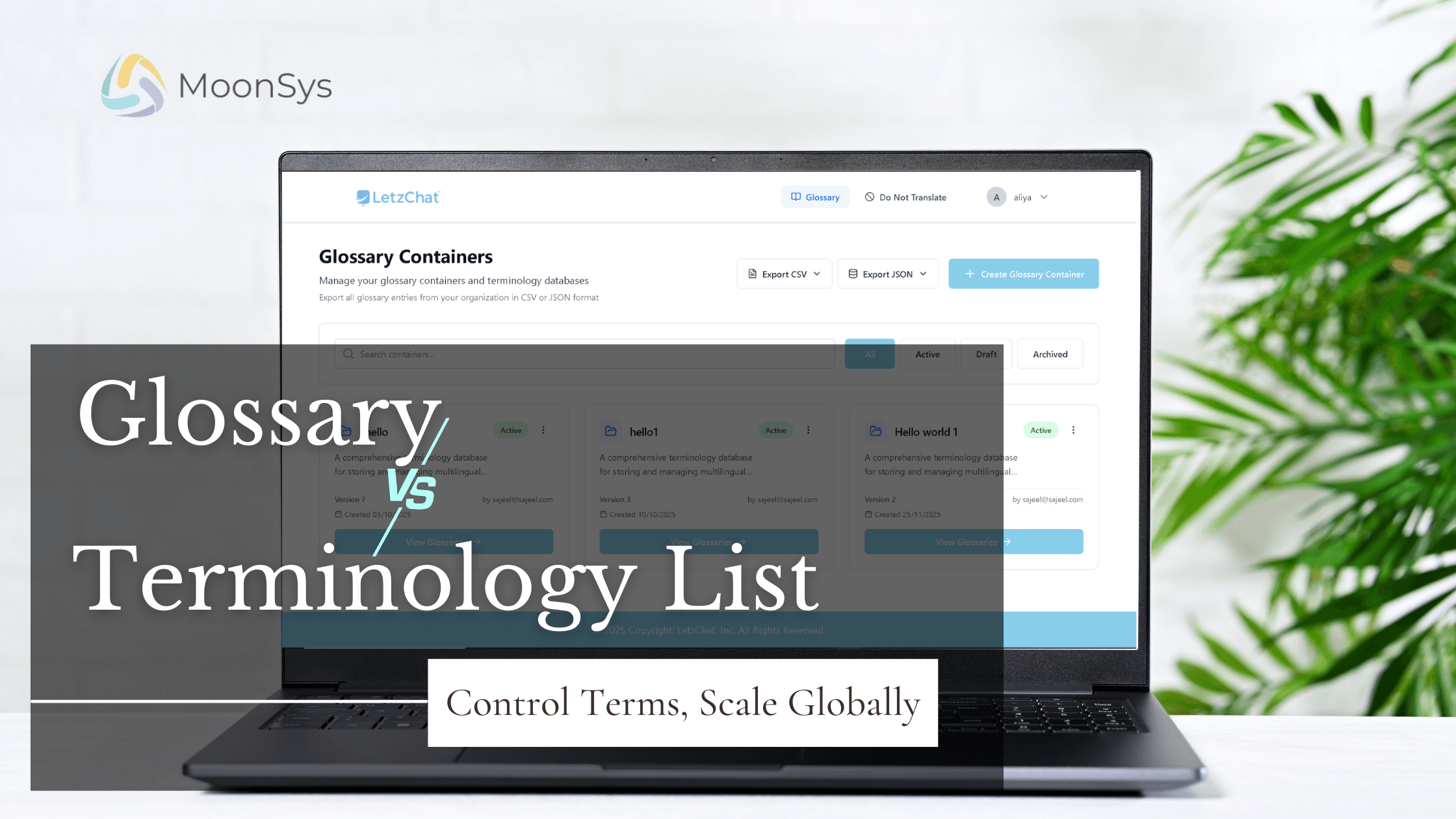 The comparison between glossary and terminology lists is one of the most frequent misconceptions that people have. The terminology list is descriptive. It shows the state of terms at a particular moment. A glossary, on the other hand, though, is prescriptive. It makes decisions about how the language will be used in the organization.
This distinction explains why many companies underestimate the importance of a company glossary. Without governance, the glossary cannot then enforce consistency and support alignment. It is no longer authoritative but rather optional. Teams follow it when it suits them and ignore it when they feel the pressure.
A genuine glossary does more than just giving definitions. It also shows the intention behind them. It tells how a term can be applied, where it can be used and what the preferred alternatives are. In practice, this subtle difference makes a significant difference.
Why Glossaries Break as Companies Scale
Scaling introduces variables that informal glossaries cannot manage as organizations grow. Having several products, serving different regions and working with multiple external partners increase the number of people who have to deal with terminology. Every group has its own interpretation and its own priorities.
In the absence of governance, inconsistencies grow. Different teams spend time arguing over the language rather than doing the work. Corrections are made at the end of the process. Gradually trust in the glossary diminishes and this strengthens the belief that glossaries are indeed ineffective.
This dynamic is one of the reasons why corporate glossaries fail so frequently. Poor definitions are seldom the cause of failure. The lack of ownership, process and visibility is what really leads to it.
What a Real Glossary Management System Includes
A genuine glossary management system overcomes these challenges by organizing the matter where informal documents fall short. It considers the terminologies as the property of everyone and, therefore, necessitates proper stewardship. This is not about introducing more bureaucracy. Rather, it is about fostering understanding even on a large scale.
A real system mainly consists of:
The management of the lifecycle that clearly indicates how terms get proposed, reviewed, approved, and eventually retired
The clear ownership models that define the stakeholders for the terminology choices
The permission controls that stop uncontrolled and unintentional changes
The validation processes that check and double-check the definitions for accuracy and relevance
The change history that tells the reasons why the decisions were made
The consistency of usage among the diverse teams, tools and geographical areas
Once the above elements are established, an internal glossary for companies turns into a reliable infrastructure instead of a dormant paper. The teams consider it trustworthy because it mirrors the present reality and not the past negotiations.
Governance Turns Language into an Asset
The implementation of governance radically transforms the role of language within the organization. The making of terminology decisions becomes a public affair. The trade-offs are recorded. The disputes are settled once and for all instead of continuing in a loop.
Rather than going back and forth on the same terminology across departments, companies develop a common view. The glossary ceases to be a source of confusion and turns into the facilitator of communication. It is precisely this transition that distinguishes advanced language management from primary documentation.
Glossary Examples in Business Environments
Mature organizations do not show any drama regarding the operation of glossaries. The product team discussed and decided to assign the name of products Marketing is always saying the same thing to their customers no matter which region the customer is in. The same words are used in support documentation as in the customers' view. These glossary examples in business indicate that the success of a glossary is measured by how widely it is used not by how visible it is.
Immature glossaries, on the other hand, are always in need of reminders and will have to be checked manually very often. They take effort without providing reliability. Eventually, teams will lose interest and the wrong conclusion that glossaries do not work will be further supported.
Reframing What a Glossary Really Is
 In order to come up with the right answer to the question of what is a glossary meaning in a corporate context, it is useful to reframe the glossary as infrastructure rather than mere documentation. Glossary acts as a bridge of communication just like the systems act in operation and management. It lessens the point of contention, maintains the intention, and makes it possible to increase the size of operations.
Once the organizations start looking at the glossaries this way, the glossaries become part of governance and not an afterthought. The language decisions are now visible. Accountability is made clear. Terminology matures purposely rather than by accident.
Audit Your Glossary Reality
Most companies are not incorrect in stating that they have a glossary. They are just talking about a different degree of maturity. The question that is more important to ask is whether that glossary is run actively and integrated with daily workflows.
Taking a Clear Look at Your Glossary
Spend some time doing an honest audit of your present-day glossary. Determine whether it is operating as a list or as a system, whether it is owned and neglected and whether it helps to maintain consistency as your organization gets bigger. The first step in making a real impact on terminology governance is to properly grasp the difference between having a glossary and managing one.