
The situation which you describe happens more often than businesses understand. Users abandon products when they discover that products become difficult to use because they need more features and innovative elements. The solution requires more than achieving visual appeal. The actual problem exists because designers created user interface and user experience systems which disregard fundamental user behavior patterns in digital environments. The current market requires companies to understand that design functions as a fundamental element which determines product achievements.
People remain interested in products which create positive experiences while they build relationships with users through trustworthy designs which drive user actions. The best technology cannot function properly when design elements do not work correctly. The design elements which make up UI and UX now function as mandatory components in modern applications.
The Good Looks Alone Are Not Enough For Success
Aesthetics function as the main focus for many teams. Users will notice clean layouts with trendy colors and animations, but these design elements will not help them stay engaged. The user experience design process needs to achieve more than visual presentation. The system needs to guide users through navigation paths which help them comprehend information while completing tasks without encountering obstacles.
Users lose their way through systems which create usability obstacles. Users begin to experience irritation because processes require multiple stages to complete. Users reach their limit because the system operates at slow speeds. Users who experience poor interactions will stop using applications, which causes them to lose interest and results in revenue decline. The combination of user interface design and UX design provides strong UX design which creates visually appealing products that work effectively.
Industry Challenges That Hurt Product Adoption
The first obstacle which businesses encounter involves their website navigation which creates confusion for users. The system requires immediate access to information but users cannot locate their required content. The system design establishes a challenging environment because it combines disorganized elements with poorly structured information. Users experience two negative effects because these elements make the system harder to use.
Websites which take too long to load create major problems for users. Users demand quick results which they consider essential for mobile device usage. Users will stop interacting with a product when they discover it operates at a slow speed. Users struggle to understand the product because branding elements function differently on different screens. The design components of the product create a separate interface which users find difficult to maintain their connection with.
The combination of low accessibility and substandard mobile responsiveness leads to decreased user engagement. The products which businesses develop without following accessibility rules will create barriers that prevent users from accessing products while exposing organizations to potential legal violations. The absence of proper usability design leads to business operations which fail to reach their full potential because they miss important market opportunities.
UI/UX as a Growth Strategy, Not a Design Task
People create successful products through their actual needs which users establish as requirements. User-centered design requires designers to study actual user needs and their behavior for product development. Designers should make decisions based on insights which they should use to prepare their design work.
UX design connects product objectives with user objectives. It combines these two elements to create an experience which increases user contentment and leads to customer acquisition. Businesses that invest in ux design principles early avoid costly redesigns later and build stronger relationships with their users. Experience serves as the primary factor which differentiates businesses in digital marketplaces.
Building UI/UX the Right Way
The initial step for digital product design success requires teams to gather user knowledge. Research helps teams identify pain points, motivations and usage patterns. Designers use user personas which combine actual data with common user behavior to create user profiles.
The team develops wireframes together with interactive prototypes to create visual representations of system structure and user interactions. The procedure produces advantages which save time and decrease project hazards. Real users test both usability and A/B testing to confirm design assumptions. The testing process identifies successful elements together with ineffective components.
Design evolution occurs through continuous development process. The organization uses data and user feedback to make ongoing design enhancements. The final UI/UX design achieves its objectives through performance and accessibility and aesthetic design elements which create user experiences that work seamlessly.
How Moonsys Delivers Impactful UI/UX Design
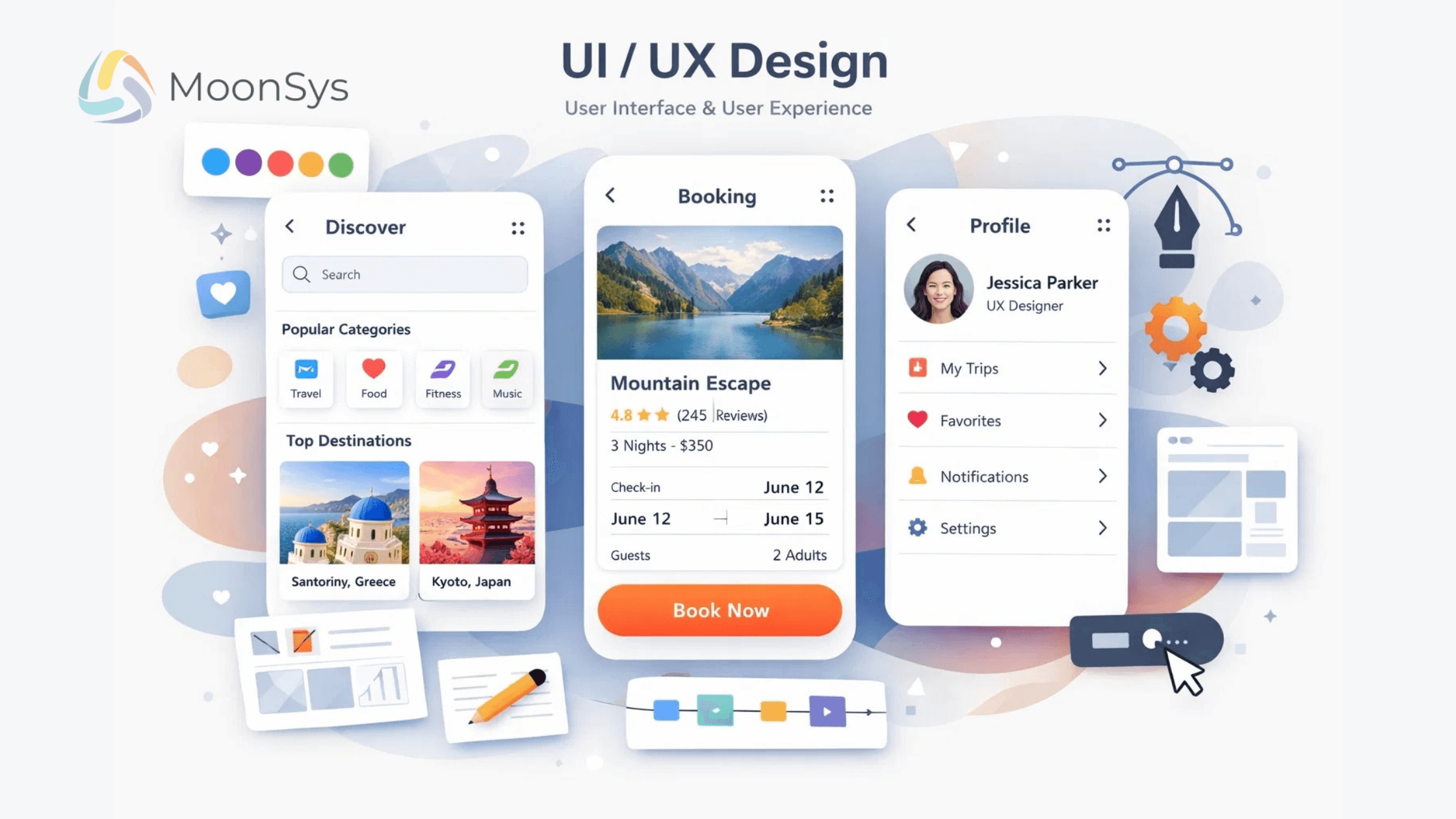 At Moonsys our product design process requires us to establish product goals before we start creating. The main goal of Moonsys UI/UX Design Services exists to develop digital experiences which increase user engagement and retention and lead to customer conversion. Our design approach centers on meeting user requirements rather than following current design trends.
The team uses ux research as the first step to discover how users interact with products while achieving business goals. The team uses these insights to create wireframes and prototypes which show how users will interact with the system. The team uses established UI UX best practices to create design elements which provide users with consistent and clear and responsive experience across different devices.
Accessibility features exist from the initial stages of our design process. Our designs meet WCAG standards which guarantee accessibility together with compliance requirements. The stakeholders use interactive prototypes to test user experience elements which they can change before development begins. The process helps decrease design work while speeding up project completion.
A Simple and Effective Design Process
Our process combines structured elements with flexible operational capabilities. We start with research to identify user needs and challenges. The wireframes establish the layout and flow of the design while visual design elements create the interactive experience. Testing usually evidences usability issues, while the phase of refinement is aimed at both accuracy and readability.
The design process uses this method to create design choices that designers can assess through active measurement. We use data combined with user feedback to make decisions instead of attempting to figure out what users need through guesswork.
Real-World Results from Better UI/UX
Well-executed UI/UX delivers measurable results. Moonsys clients experience a 35% increase in user interaction because their customers find products simpler and more pleasant to use. The retention rate increases because user drop-offs decrease by 25 percent, and this leads to the enhancement of customer loyalty. Businesses should remove all process barriers because this action will lead to better conversion rates. The client experienced a 30% boost in checkout completion after their e-commerce platform received a UX redesign. The product design process needs exact execution because it will determine business results.
Why UI/UX Is the Foundation of Product Success
User experience design creates the experience that customers have which decides their product purchase decisions. The design affects user trust and their ability to feel confident about using the product. Products that prioritize experience deliver better results than products that rely solely on their features. Strong UI/UX design creates first-time users who become dedicated customers.
“Good design does not only simply define the look, but it must also create the user's feeling and help aid the user's performance.”
Better experience design than adding new features will lead to your product solving engagement and retention problems while increasing conversion rates.